
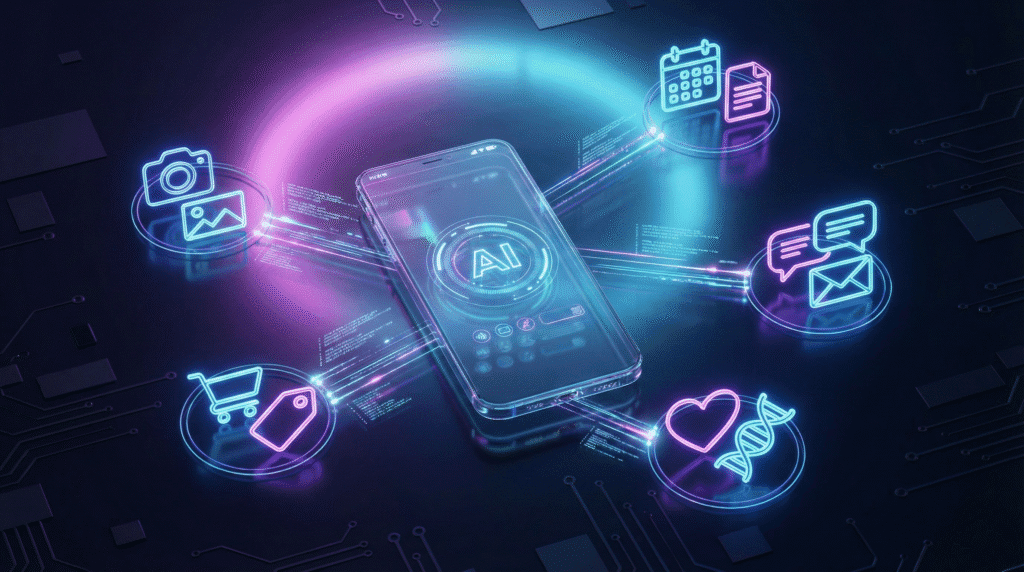

Do you ever wonder how your apps seem to “know you”, like recommending the perfect filter for your selfie or automatically sorting your photos? That is AI transforming everyday apps in 2025. In this article, you’ll learn exactly what changes have happened, how apps around you are more intelligent than before, and what that means for you.
What “AI transforming everyday apps” really means
When we say “AI transforming everyday apps,” we mean this: apps you use daily, like photo editors, health apps, note-taking tools, and chat apps, are now powered by innovative technologies. These apps can adapt, predict, suggest, and even create things for you. They no longer just react to your taps; they anticipate what you need.
In 2025, this is becoming the new normal.
Why AI became essential in apps by 2025
AI is no longer a niche or luxury. It’s now a core part of many apps because:
- Users expect personalization. People want apps that feel personal, showing content or features based on their habits. AI enables that. (AI Innovation)
- People want convenience. AI automates repetitive tasks, no more manual sorting, tagging, or typing. (apptunix)
- Complex tasks became easier. Tasks like photo editing, scheduling, or health tracking used to need time and skill. With AI, they become simple for anyone.
- Tech evolution made it possible. Advances in machine learning, computer vision, natural language processing (NLP), and edge computing have made AI faster, cheaper, and more efficient. (designmonks.co)
Because of these, many everyday apps have adopted AI, transforming them into smarter tools.
Main technologies powering AI apps today
Behind the scenes, several AI technologies are doing the heavy lifting:
- Machine learning (ML): Allows apps to learn from user behavior and improve over time.
- Computer vision: Lets apps “see” for example, recognizing objects, people, or food in photos.
- Natural Language Processing (NLP): Helps apps understand human language typed or spoken for chatbots, virtual assistants, or voice commands.
- Predictive analytics: Let’s apps forecast what you might like or need, based on patterns.
- Edge-AI & on-device AI: Moves some AI processing from cloud servers to your phone, making tasks faster and more privacy-friendly. (WeblineIndia)
These technologies combine to make apps smarter, faster, and more responsive.
How everyday mobile apps use AI now
Let’s look at some real-world categories where AI is already transforming popular apps in 2025.
Photo and image apps
AI has reshaped how we edit photos and how we think about selfies.
- Apps can auto-tag or categorize photos by people, objects, or scenes. For example, some apps now use AI to sort photos automatically instead of you entering tags manually. (convin.ai)
- Virtual makeover and editing apps let you try new hairstyles, outfits, or even backgrounds with a few taps. For example, some AI-powered apps generate hyper-realistic images from selfies. (Synthesia)
- Generative tools now allow users to create new images, stylize photos, or remove backgrounds using simple text prompts. This makes content creation easy for non-designers. (saner.ai)
These features make image apps more powerful, creative, and accessible than ever.

Productivity and office apps
AI is making work apps smarter and more efficient.
- Many tools offer writing help, grammar correction, and content suggestions. That makes writing emails, reports, or social-media posts faster and better. (Zapier)
- AI-driven scheduling, reminders, and task automation reduce the load of repetitive work, letting you focus on important tasks. (TTMS)
- Some apps use AI to summarize meetings, transcribe audio, or analyze data saving time and boosting accuracy. (Zapier)
In short, productivity apps no longer just store data, they help you act smarter.
Health & wellness apps
AI is changing how health and wellness apps support our daily lives.
- Some apps now use computer vision to recognize food items and estimate nutritional content, making meal tracking easier and more accurate. (arXiv)
- Others help with remote health monitoring, like tracking wounds or chronic conditions via AI-based image analysis and reporting to doctors. (arXiv)
- AI chatbots are being used to offer guidance, reminders, and mental-health support. (That said, privacy and data security become critical in these apps, more on that later.) (linvelo.com)
These innovations make health tracking more personalized, accessible, and convenient.
Communication and assistant apps
AI-powered assistants and smart chat features are now common.
- Voice assistants and chatbots in messaging apps can help you set reminders, search, translate, or schedule things. AI makes them conversational and simple. (WeblineIndia)
- Some AI assistants allow cross-app actions: for example, from 2025, certain AI assistants let you do several tasks across multiple apps with one prompt like find a restaurant, share it with a friend, and set a calendar reminder, all at once. (The Verge)
- AI also improves accessibility: for instance, helping users with disabilities by describing images, reading text aloud, or offering tailored assistance. (Wikipedia)
Communication apps are no longer passive; they act, assist, and make life smoother.
AI helping designers and creators: app design and content tools
AI isn’t just for end-users; it’s also changing how apps and content are built.
- Designers can now use AI-powered tools that take a prompt or simple input and generate full app layouts or design mockups. Tools like these cut down design time by hours or days. (designmonks.co)
- Content creators benefit too. AI helps generate images, edit videos, write scripts or posts, and even suggest improvements to tone or style. (Synthesia)
- For non-designers or small businesses, AI design tools lower the barrier to creating polished apps or marketing creatives without hiring a large team.
With these, creativity becomes more accessible.
Business and work apps using AI: automation, data & decision support
Beyond personal apps, AI is reshaping how businesses build and use apps daily.
- AI automates repetitive workflows, customer support, data entry, scheduling, and analytics, freeing staff time for more strategic work. (apptunix)
- It helps with real-time decision support by analysing large data sets quickly and offering insights speeding up decisions and reducing errors. (apptunix)
- Collaboration tools now embed AI for example, smart meeting notes, automatic summaries, or task recommendations making remote and hybrid work smoother. (apptunix)
In 2025, businesses both big and small treat AI in apps as a must-have, not a “nice-to-have.”
What’s new in 2025: trends and next-gen features
AI in apps continues evolving quickly. Here are what’s trending now and what to expect soon.
Cross-app, multi-step AI assistants
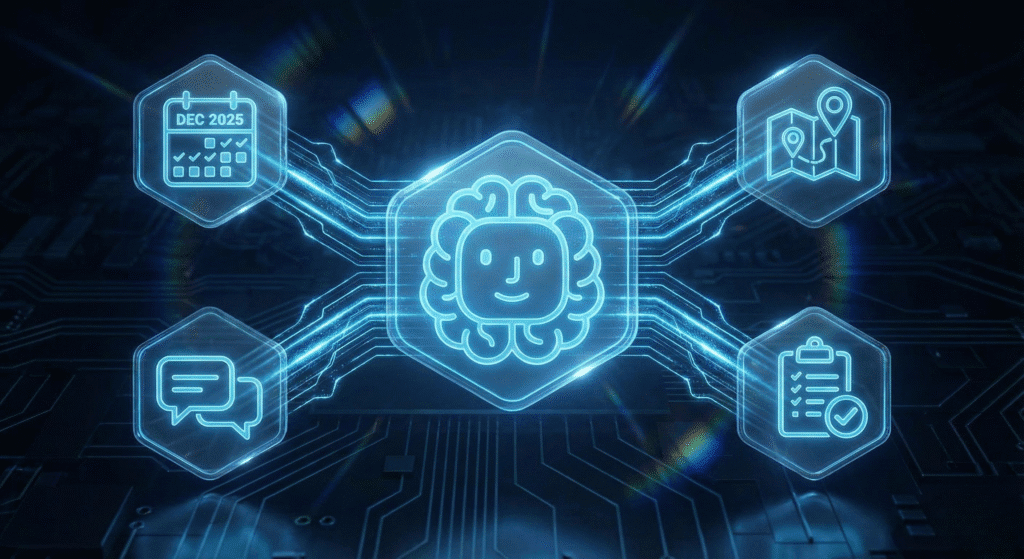
In 2025, AI assistants can do more than work inside a single app. They can coordinate between several apps.
For example, an assistant might help you search for a restaurant, share it with a friend, and add a calendar event, all from a single prompt. (The Verge)
These multi-step AI assistants make digital life feel more unified and effortless.
Edge-AI, privacy, and on-device intelligence
As AI becomes more privacy-conscious, many apps now run AI functions on your device rather than sending data to the cloud. This improves speed and reduces privacy risks. (designmonks.co)
This shift is especially important for sensitive apps like health, finance, or private messaging.
AI + AR/VR immersive and creative futures
AI is merging with augmented reality (AR), virtual reality (VR), and creative tools. That means soon you may have apps that let you try on clothes virtually, redesign your room layout, or visualize ideas in 3D all powered by AI. (tech-stack.com)
These immersive AI-powered experiences will make apps more interactive, realistic, and fun.
Risks and challenges: privacy, security, bias, over-automation
With all the benefits, AI in apps still brings risks.
- Privacy & data security: Many AI apps collect personal data or sensitive info. If not managed well especially in health or finance apps this can be risky. Recent studies show some AI-based health apps have security and privacy concerns. (arXiv)
- Bias and fairness: AI learns from data. If data has bias, AI may make unfair predictions or suggestions. We must stay cautious.
- Over-automation and loss of human touch: Automating everything might make life easier but sometimes human judgment, creativity, or empathy matters more.
- Dependence and data ownership: Heavy reliance on AI may raise questions about who owns your data, who controls AI decisions, and what happens if the AI fails.
Therefore, using AI apps wisely and demanding transparency is crucial.
What this all means for users and creators (you!)
If you are a user:
- Expect apps to become smarter, more helpful, and more personalized.
- Use them to save time in photo editing, health tracking, scheduling, content creation.
- But stay aware: check permissions, privacy policies, and what data the app collects.
If you are a creator or developer (or content publisher):
- You now have powerful tools to build smarter apps or create content faster.
- You can use AI-driven design, content generation, and analytics tools to save time and scale.
- But you should be careful about ethics, data privacy, and user trust.
Conclusion: How to prepare for an AI-powered app world
AI transforming everyday apps in 2025 is not a future idea it’s your reality right now. Apps are smarter, more intuitive, and more helpful than ever before.

To benefit fully, stay curious. Explore new AI-powered tools. Use apps that respect your privacy. And if you build or create apps/ content, embrace AI as a tool but combine it with human judgment and care.
The future of apps is intelligent. So let’s step into it with eyes wide open.
🔎 FAQs
Q: What kinds of everyday apps now use AI in 2025?
A: Many kinds of photo apps, productivity and office tools, health and wellness apps, communication/assistant apps, design and creative apps, and business workflow apps.
Q: How does AI improve the experience in mobile apps?
A: AI helps by offering personalization, automating repetitive tasks, making content creation easier, giving intelligent suggestions, and enabling features like image recognition or predictive analytics.
Q: Is it safe to use AI apps for health or personal data?
A: It can be, but only if the app handles data responsibly. Some AI apps have shown privacy or security vulnerabilities. Always check privacy policies and app permissions.
Q: Will AI replace human designers or creators soon?
A: Unlikely. AI is a tool it can speed up work and help with ideas, but human creativity, judgment, and ethics remain important.
Q: What is the big trend for AI apps beyond 2025?
A: Expect more cross-app assistants, on-device AI for better privacy, AI + AR/VR immersive apps, and smarter automation in creative, health, business, and everyday life apps.
Sources Used
- “AI in Mobile Apps: The 2025 Guide” WeblineIndia (WeblineIndia)
- “AI in Everyday Business: Examples and Trends for 2025” Apptunix blog (apptunix)
- “The 45 Best AI Tools in 2025” Synthesia / compiled list (Synthesia)
- “25 Practical Examples of Using AI in Daily Life – 2025 Guide” Dume.ai summary article (Dume.ai)
- “On the Security and Privacy of AI-based Mobile Health Chatbots” November 2025 empirical study (arXiv)
- “NutrifyAI: AI system for food detection and meal recommendations” research paper August 2024 (arXiv)
- “Top 6 AI Mobile App Design Tools & Trends for 2025” DesignMonks review May 2025 (designmonks.co)